
Russell County Tax Record Fields
The Russell Public GIS/CAMA search ties each parcel to its assessment fields, while the Revenue office answers questions about current classification, exemptions, millage, collections, and bills. Treat the fields as a set. The displayed annual tax is not a simple percentage of appraised value.
| Field | What It Shows | Where |
|---|---|---|
| Land and building | Separate appraisal components | CAMA parcel card |
| Appraised value | County's displayed full-value estimate | CAMA parcel card |
| Assessed value | Appraised value after the class ratio | Revenue assessment record |
| Exemption and class | Parcel-specific tax treatment | Revenue office and current record |
| Annual tax | A displayed yearly amount needing year and status | CAMA and Revenue verification |
| Bill or delinquency | Amount due, paid status, or sale-stage lead | Revenue or ALDOR route |
ALDOR lays out the formula plainly. Appraised value times the assessment ratio gives assessed value. Assessed value times millage gives the tax. One mill equals .001. The math still demands the right parcel class, local millage, exemptions, district, and any cap. It cannot turn an old CAMA amount into a current bill.
Russell County Assessment Math
Alabama's assessment guidance sorts property into four classes. Class I utilities carry a 30 percent ratio. Class II property generally uses 20 percent. Class III covers qualifying agricultural, forest, and owner-occupied single-family residential property at 10 percent. Class IV personal vehicles use 15 percent. Check the parcel's class on the record rather than guessing from how it looks.
Run the numbers to see why class matters. An appraised value of $200,600 yields $40,120 at the Class II ratio of 20 percent. It yields $20,060 at a qualifying 10 percent Class III ratio, before exemptions, caps, and other adjustments. Take an assessed value of $40,120 with 50 total mills applied. The pre-adjustment product is $2,006. These figures are math examples only, not a Russell County bill estimate.
- Appraised value
- The county's displayed estimate before the class ratio.
- Assessed value
- The appraised value multiplied by the applicable assessment ratio.
- Millage
- The levy applied to assessed value; one mill equals .001.
- Homestead exemption
- Relief that may apply to a qualifying owner-occupied home.
Read Russell County CAMA Taxes
A Russell CAMA result grid can display parcel, owner, addresses, district, land, improvements, total market, an exemption indicator, deed date and instrument, yearly tax, and neighborhood. The parcel card adds legal description, acreage, building detail, and separate value components. Search options include street, owner, parcel, subdivision, district, book-page, deed date, value range, and Section/Township/Range.
One public Russell County parcel card shows the layout. The card holds land, building, appraised, annual-tax, deed-reference, and improvement fields in place.
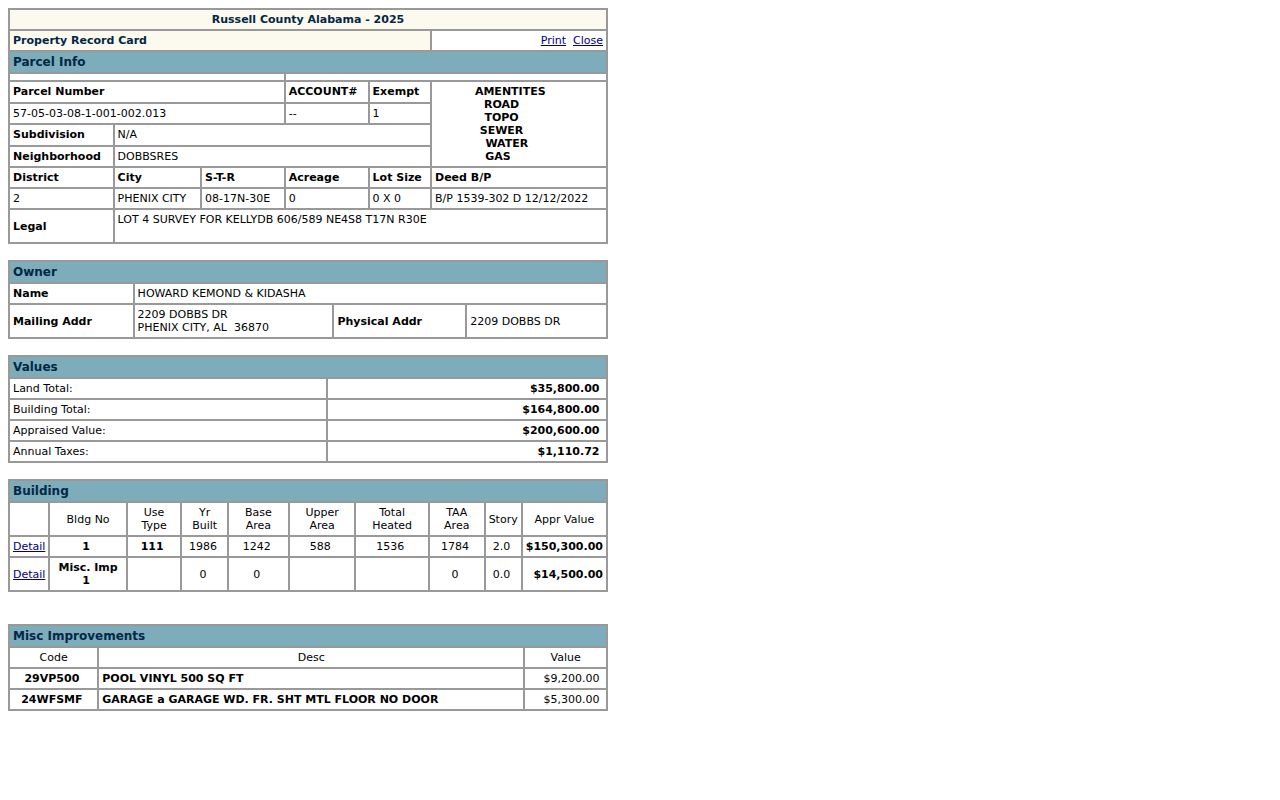
The example teaches where tax and appraisal fields sit on the card. It is not a current bill or a comparable sale. Public cards can show very different annual amounts because values, class, exemptions, districts, improvements, caps, and years all vary.
Check a Russell County Tax Account
Russell County publishes no stable online tax-bill result interface or current county millage table. Start from the CAMA parcel key, then reach Russell Revenue through the ALDOR county-office directory. Ask for the exact tax year, assessed value, classification, exemptions, millage district, amount billed, payments, balance, and any delinquent status.
- Find the parcel in CAMA by address and save its parcel number.
- Record the displayed value components, annual tax, exemption indicator, district, and access date.
- Ask Revenue to confirm the current bill, class, exemptions, millage, payments, and balance.
- If delinquency appears, verify the parcel and the exact sale or redemption stage.
The Revenue Commissioner sits at 1000 Broad Street, Phenix City, with mail to P.O. Box 669. The directory lists 334-298-6922 and 334-298-7011. Mapping and Appraisal keep separate contacts. Use the tax side for bill and collection facts, and the mapping or appraisal side for parcel and value questions.
Alabama's Seven Percent Cap
ALDOR's Act 2024-344 guidance sets an annual 7 percent cap on taxable assessed-value increases. It covers qualifying Class II and Class III real property, subject to stated conditions. The base-year framework began October 1, 2024. Related collections start October 1, 2025.
The cap limits neither market value nor appraised value to 7 percent growth. It is also not a 7 percent tax rate. Confirm that the parcel and the change qualify. Check which base year the county applied, and whether any exception applies. A transfer, new improvement, class change, exemption change, or district change can make a plain year-to-year comparison misleading.
Russell County Delinquent Tax Trails
ALDOR's delinquent-property guidance walks through state-held transcripts, applications, certificates, tax deeds, and redemption. State transcript lists update weekly. They leave out physical addresses, so reconcile any parcel or tax identifier with Russell Revenue and CAMA first. A matching name alone proves nothing.
The Alabama Book of Lands is open during posted weekday hours. State guidance places county tax auctions on the first Monday in May. Current Russell County notices control the local event. A transcript, certificate, tax deed, sheriff sale, and later clear title are distinct stages. ALDOR warns plainly that a certificate or tax deed does not by itself clear title.
Before acting on a delinquency lead, verify the parcel, owner field, tax year, balance, notice, and sale status. Also check the redemption period, prior encumbrances, and later recorded instruments. The deed side of that check belongs with Russell Probate.
Sale-stage warning. A delinquent list or tax-sale document is a dated lead, not proof that a parcel is currently available or carries clear title.
Contest a Russell County Assessment
A Russell County taxpayer who disputes a value has a formal route: a written protest to the County Board of Equalization. ALDOR's appeal answer sets the deadline at 30 days after the written notice. The real-property guidance rests on Alabama Code §§40-3-20, 40-3-24, and 40-3-25, with §§40-7-74 and 40-2-11 supplying reappraisal context.
Save that notice and its mailing date. Request current filing instructions and proof of receipt from the county. Good evidence speaks to the record being challenged: parcel identity, property facts, condition on the valuation date, land or building errors, relevant sales, class, exemption, and any wrong district. A deed price alone rarely settles the valuation method.
A bill dispute is a different animal. Pin down whether the problem is class, exemption, millage, payment credit, penalty, or delinquency. That routing sends the question to the right corner of the Revenue office. Miss the protest window and your options narrow. Rely on the written notice and current county directions.
Bring the assessment notice, parcel card, photographs or measurements tied to the county appraisal, the current tax bill, and papers that correct the property's facts. Keep copies of everything filed, with dates. A recorded deed or plat that changes acreage or parcel identity should come from Russell Probate. The Board works from the assessment record, so the connection between documents has to be spelled out rather than assumed. Explain how the instrument relates to that record. Do not ask the Board to infer the link.
Appeal window. File a written value protest with the Russell County Board of Equalization within 30 days after written notice, subject to current county instructions.
Verify Russell County Tax Figures
A sound tax check starts with the source date and the parcel's exact identity. Record the CAMA parcel number, physical address, legal-description fragment, assessment district, land value, improvement value, total appraised value, exemption indicator, annual tax, and deed reference. Then ask Revenue about the current tax year, class, assessed value, exemptions, millage district, cap treatment, amount billed, payments, and balance.
Do not infer a tax rate from two parcel cards. Sample Russell County cards display annual taxes of $1,110.72, $1,345.68, $1,273.36, and $166.72, but they differ in appraisal, improvements, location, deed year, class, exemption, district, and other factors. Those figures show field layout only. They are not a rate table or a safe comparison set.
Land and improvement searches can isolate a disputed fact. The CAMA Land Search includes method, forest-land, schedule, unit price, quantity, acres, land value, subdivision, and district. Improvement Search includes use, description, code, value, condition, size, and other building measures. Ask Mapping/Appraisal what each local code means before treating it as a physical inspection or permit record.
A recorded deed may explain a transfer date or legal description, and a plat may explain a new parcel number. Neither document states the current payment balance. Likewise, a CAMA annual-tax line does not show whether a bill was paid after the card was produced. Keep assessment evidence, collection evidence, and recorded land evidence in separate columns, then reconcile them by parcel and year.
When a dedicated page or portal fails, Alabama Code §36-12-40 supports a custodian-specific public-writing request subject to record exceptions. Identify the parcel, year, exact record, delivery method, and whether certification is needed. Ask for a fee estimate. Do not request protected tax-return or financial material, and do not publish account identifiers that the property question does not need.
For a rural parcel, preserve the acreage and Section/Township/Range exactly as shown. For a city parcel, confirm the assessment district and municipal label. Neither field alone proves the current city boundary or the tax districts that applied in another year.
Russell County property tax records work best as dated snapshots. Compare Russell County property tax figures by the same year, class, and district. When a number changes, use the current Russell County property tax notice and Revenue confirmation. Archived Russell County property tax records may still explain an older deed or appeal, but they do not replace today's account status.